Everything You Need to Know About Ramayana Trail Sri Lanka 2026 | Complete Guide to Sacred Sites & Pilgrimage
Ramayana Trail Sri Lanka: The Complete Guide to the Sacred Sites The Ramayana Trail is one of the world’s great spiritual journeys. For millions of Hindus across India, Sri Lanka, and the world, the Ramayana is not just an epic — it is a living story, recited in homes, performed in temples, and passed down […]
Ramayana Trail Sri Lanka: The Complete Guide to the Sacred Sites
The Ramayana Trail is one of the world’s great spiritual journeys. For millions of Hindus across India, Sri Lanka, and the world, the Ramayana is not just an epic — it is a living story, recited in homes, performed in temples, and passed down through generations.
Sri Lanka — known in the epic as Lanka, the island kingdom of King Ravana — is home to over 50 locations connected to the Ramayana. Approximately 25 of these sites have road access and are open to pilgrims and travellers today. Each one carries a story, a legend, and a tangible connection to the epic that has shaped South Asian culture for millennia.
This guide explores the Ramayana Trail in Sri Lanka — the sacred sites, the legends behind them, and how to plan your own pilgrimage through the island of Lanka.
What Is the Ramayana Trail?
The Ramayana Trail is a network of over 50 sites across Sri Lanka connected to the Hindu epic Ramayana. Approximately 25 of these sites have road access and are open to pilgrims and tourists today.
Key facts:
| Detail | Information |
|---|---|
| Total Sites | 50+ locations |
| Accessible Sites | ~25 with road access |
| Recommended Duration | 7–14 days |
| Main Regions | Cultural Triangle, Hill Country, East Coast, North, South Coast |
| Best Time to Visit | December to March (south/west), May to September (east) |
| Significance | Spiritual, cultural, historical |
Why Sri Lanka for a Ramayana Pilgrimage?
The Ramayana tells the story of Lord Rama, his wife Sita, and his brother Lakshmana. When Sita is abducted by Ravana, the demon king of Lanka, Rama embarks on a quest to rescue her — a quest that leads him across India and across the sea to Lanka itself.
Sri Lanka is where the epic reaches its climax:
-
Hanuman leaps across the ocean
-
Sita is found in Ashok Vatika
-
The great battle is fought
-
Ravana falls
-
Sita undergoes her trial by fire
For pilgrims, the Ramayana Trail is not just a tour. It is a spiritual journey — a chance to walk in the footsteps of the epic’s heroes and experience the story in a new, profound way.
As one scholar put it, “These places are revered not for archaeology but for their connection to spiritual and narrative truths.”
The Key Ramayana Sites in Sri Lanka
1. Munneswaram Temple, Chilaw
The Legend: According to tradition, Lord Rama visited this temple after defeating Ravana to pray to Lord Shiva for forgiveness — to rid himself of the “Brahmahathi Dosham” for killing Ravana. Munneswaram means “the first temple for Shiva.”
What to See:
-
Ancient Shiva temple with centuries of history
-
Vibrant festivals and daily rituals
-
A place of deep spiritual significance
Location: Chilaw, Western Province
Best Time: Year-round
2. Manavari Temple, Chilaw
The Legend: Manavari is the first place where Lord Rama installed a Shiva lingam. This lingam is known as the Ramalinga Shivan — the only lingam in the world named after Lord Rama, apart from Rameshwaram in India.
What to See:
-
The Ramalinga Shivan lingam
-
Serene temple grounds
-
A place of pilgrimage for thousands of devotees
Location: Chilaw, Western Province
Best Time: Year-round
3. Koneswaram Temple, Trincomalee
The Legend: Perched dramatically on Swami Rock overlooking the Indian Ocean, Koneswaram Temple is one of the most important Hindu temples in Sri Lanka. It is said to be one of the places where Ravana prayed to Lord Shiva.
What to See:
-
Dramatic clifftop setting with panoramic ocean views
-
Ancient temple architecture
-
The famous Lover’s Leap cliff nearby
Location: Trincomalee, Eastern Province
Best Time: May to September
4. Sita Kotuwa, Hasalaka
The Legend: Sita Kotuwa, meaning “Sita’s Fort,” is believed to be the place where Sita was first held captive by Ravana before being moved to Ashok Vatika.
What to See:
-
Archaeological ruins
-
Legendary connection to Sita’s captivity
-
Scenic surroundings with waterfalls and streams
Location: Hasalaka, Central Province
Best Time: Year-round
5. Seetha Amman Temple, Nuwara Eliya
The Legend: The Seetha Amman Temple is one of the most important Ramayana sites in Sri Lanka. Located near Ashok Vatika, it is believed to be the place where Sita was held captive by Ravana.
What to See:
-
Ancient statues of Rama and Sita
-
Intricate carvings and vibrant architecture
-
Footprints akin to Lord Hanuman’s found by the nearby stream
Recent Development: In August 2025, the Ashok Vatika Meditation Centre was inaugurated at the Sita Temple in Seetha Eliya, funded through private donations from devotees in India.
Location: Seetha Eliya, Nuwara Eliya District
Best Time: Year-round
6. Ashok Vatika / Hakgala Botanical Garden
The Legend: Ashok Vatika is the garden where Ravana kept Sita captive. Today, it is identified with the Hakgala Botanical Garden, one of the pleasure gardens of King Ravana.
What to See:
-
Beautiful gardens with a wide variety of flowers and orchids
-
Legendary connection to Sita’s captivity
-
Scenic mountain views
The Story: It was here that Hanuman met Sita, bringing her Rama’s ring with the news that Rama was looking for her.
Location: Hakgala, Nuwara Eliya District
Best Time: Year-round (best in dry season, January to April)
7. Ravana Falls and Ravana Cave, Ella
The Legend: Ravana Falls is a breathtaking waterfall that cascades into several falls. King Ravana is said to have lived in one of the caves above the waterfall, and it was here that he is believed to have hidden Sita.
What to See:
-
Spectacular waterfall views
-
Ravana Cave (accessible by trek — approximately 700 steps)
-
Scenic hill country landscapes
Location: Ella, Uva Province
Best Time: Year-round
8. Divurumpola Temple
The Legend: Divurumpola Temple is the place where Sita performed her Agni Pariksha (fire test) to prove her purity to Rama. Continuing the practice for thousands of years, villagers still pledge their fidelity or take oaths there.
What to See:
-
Sacred temple with deep historical significance
-
A place where couples still take vows of fidelity
-
Peaceful surroundings
Location: Nuwara Eliya District
Best Time: Year-round
9. Sri Bhakta Hanuman Temple, Ramboda
The Legend: In the hills of Ramboda where Hanuman was searching for Sita, the Chinmaya Mission of Sri Lanka built the Sri Bhakta Hanuman Temple. It is visited by thousands of devotees every year.
What to See:
-
16-foot idol of Lord Hanuman
-
Serene temple grounds
-
Panoramic views of the surrounding hills
Location: Ramboda, Nuwara Eliya District
Best Time: Year-round
10. Kataragama Temple
The Legend: Kataragama is the temple of Lord Karthikeya Subramaniam. According to the Ramayana, Lord Karthikeya — the Senapathi of the Gods — was requested by Lord Indra to support Lord Rama.
What to See:
-
One of the most important Hindu temples in Sri Lanka
-
Daily pooja ceremonies
-
Multi-religious significance (sacred to Hindus, Buddhists, and Muslims)
Location: Kataragama, Uva Province
Best Time: Year-round (festival season July-August)
11. Kelaniya Temple
The Legend: After Ravana’s death, Vibhishana was crowned as King of Lanka by Lakshmana at Kelaniya. The Kelani River is mentioned in the Valmiki Ramayana, and Vibhishana’s palace was said to be on the banks of this river.
What to See:
-
Buddhist temple with murals depicting Vibhishana’s coronation
-
Historical and spiritual significance
-
Close to Colombo
Location: Kelaniya, Western Province
Best Time: Year-round
12. Rumassala, Galle
The Legend: Rumassala is believed to be one of the pieces of the Sanjeevani mountain (the Himalayan herb mountain) that Hanuman carried to heal Lakshmana.
What to See:
-
Scenic hill with views over Galle
-
Legendary connection to Hanuman’s journey
-
Nearby beaches and Galle Fort
Location: Galle, Southern Province
Best Time: November to April
13. Ussangoda National Park
The Legend: Ussangoda is believed to be one of the areas torched by Hanuman’s burning tail when the Rakshasas set it on fire. It is also said to have been an airport used by King Ravana.
What to See:
-
Unique landscape with reddish soil
-
Coastal views
-
Legendary connection to Hanuman and Ravana
Location: Hambantota District, Southern Province
Best Time: Year-round
14. Rama Setu (Adam’s Bridge)
The Legend: The Rama Setu is a chain of limestone shoals connecting Rameswaram in India to Mannar Island in Sri Lanka. According to the Ramayana, it was built by the Vanara army to allow Rama to cross to Lanka.
What to See:
-
The fabled bridge (partially submerged)
-
Mannar Island
-
Coastal views
Location: Mannar, Northern Province
Best Time: Year-round
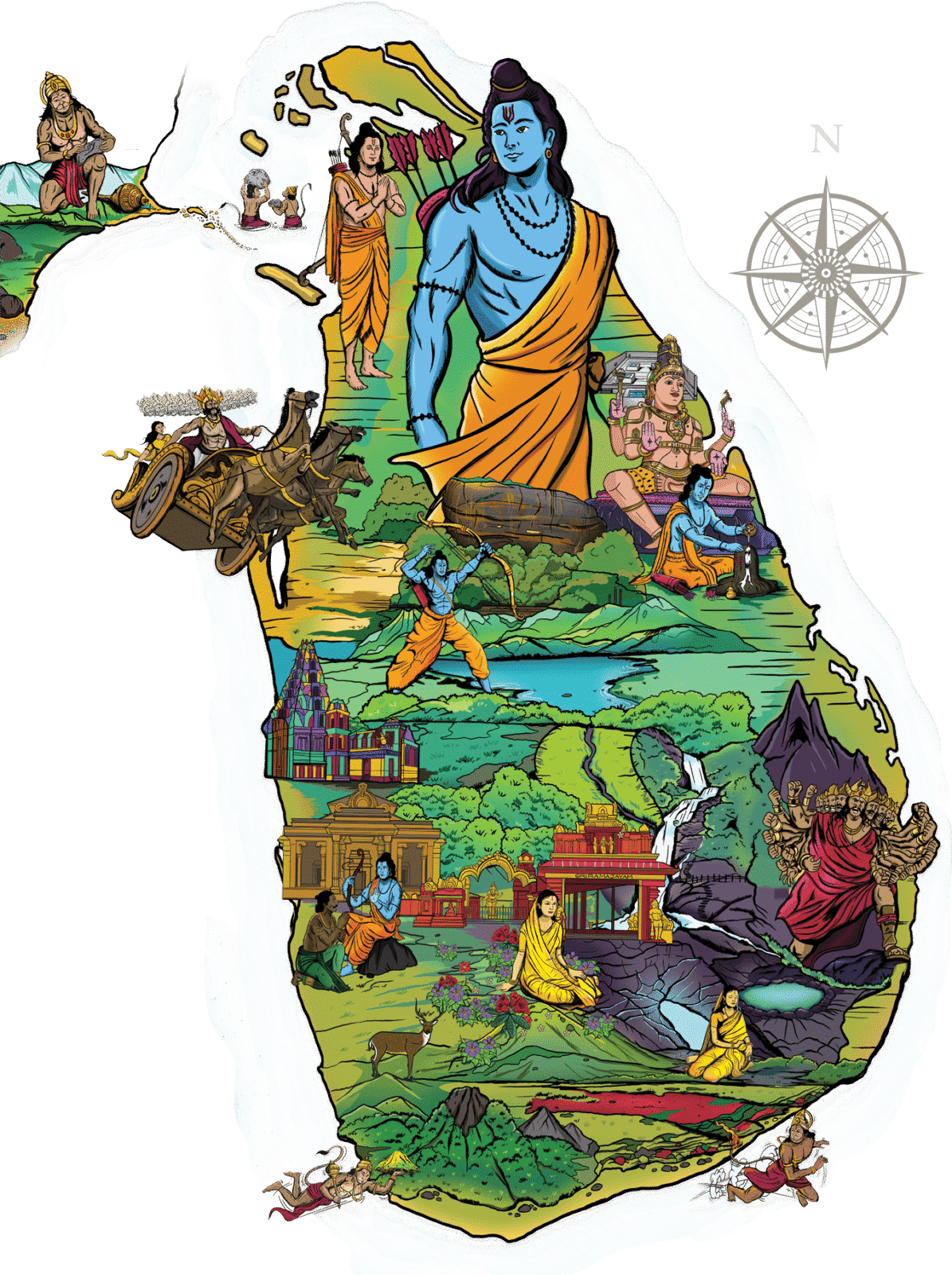
Ramayana Trail Map: Key Locations
| Site | Region | Distance from Colombo |
|---|---|---|
| Munneswaram | Chilaw | 80 km |
| Manavari | Chilaw | 80 km |
| Kelaniya | Colombo | 10 km |
| Seetha Amman | Nuwara Eliya | 180 km |
| Ashok Vatika | Hakgala | 180 km |
| Ravana Falls | Ella | 200 km |
| Divurumpola | Nuwara Eliya | 180 km |
| Ramboda Hanuman | Ramboda | 150 km |
| Kataragama | Kataragama | 230 km |
| Koneswaram | Trincomalee | 260 km |
| Rumassala | Galle | 120 km |
| Ussangoda | Hambantota | 200 km |
| Rama Setu | Mannar | 300 km |
Planning Your Ramayana Trail Pilgrimage
How Many Days Do You Need?
The Sri Lanka Tourism Development Authority recommends at least 9 nights of stay to properly experience the Ramayana Trail. However, tours range from 5 to 21 days, depending on how many sites you wish to visit.
| Duration | Coverage |
|---|---|
| 5–6 days | Main sites in a compact loop |
| 8–10 days | Comprehensive Ramayana pilgrimage |
| 14+ days | Deeper exploration, combined with other experiences |
Sample 8-Day Ramayana Itinerary
| Day | Location | Sites |
|---|---|---|
| 1 | Negombo/Colombo | Arrival, rest |
| 2 | Chilaw | Munneswaram, Manavari |
| 3 | Trincomalee | Koneswaram Temple |
| 4 | Dambulla/Sigiriya | Dambulla Cave Temple, optional Sigiriya |
| 5 | Kandy | Temple of the Tooth, Sita Kotuwa |
| 6 | Nuwara Eliya | Seetha Amman Temple, Ashok Vatika |
| 7 | Ella | Ravana Falls, Ravana Cave |
| 8 | Colombo | Departure (optional Divurumpola) |
What to Wear
When visiting temples during the Ramayana Yatra, traditional wear is required (Sri Lankan or Indian style). Visitors should note that some temples have a restriction on shirts for men — they may be required to be topless (without any shirt).
General Temple Guidelines:
-
Men: Some temples require removing shirts; otherwise, wear modest clothing
-
Women: Modest clothing covering knees and shoulders; a shawl may be carried for additional coverage
-
All visitors: Remove footwear before entering temples
-
Follow temple customs and photography guidelines
Best Time to Visit
The Ramayana Trail can be followed year-round. However, the best time depends on the regions you plan to visit:
| Region | Best Time |
|---|---|
| South & West Coast | December – March |
| East Coast (Trincomalee) | May – September |
| Cultural Triangle | Year-round |
| Hill Country | Year-round |
| North (Mannar) | Year-round |
The Ramayana Trail: A Living Bridge of Faith
For pilgrims, the Ramayana Trail in Sri Lanka is more than a series of sites. It is a living bridge of faith between India and Sri Lanka — a shared heritage that continues to shape the soul of both nations.
As one travel writer observed, “The trail can’t be complete without mention of the fabled Rama’s Bridge or Adam’s Bridge, a chain of limestone shoals that connect Rameswaram to Sri Lanka’s Mannar Island. While most of the structure lies submerged today, satellite images show a curious formation in the shallow waters that has long fascinated scientists and believers alike.”
Whether you are a devout pilgrim, a student of mythology, or simply a traveller drawn to sacred places, the Ramayana Trail offers an experience that is both deeply meaningful and profoundly memorable.
Frequently Asked Questions
What is the Ramayana Trail in Sri Lanka?
The Ramayana Trail is a network of over 50 sites across Sri Lanka connected to the Hindu epic Ramayana. Approximately 25 of these sites have road access and are open to pilgrims and tourists today.
How many days do I need for a Ramayana tour in Sri Lanka?
Sri Lanka Tourism recommends at least 9 nights to properly experience the Ramayana Trail. Tours range from 5 to 21 days, depending on the number of sites visited.
What are the most important Ramayana sites in Sri Lanka?
Key sites include Seetha Amman Temple, Ashok Vatika (Hakgala Botanical Garden), Ravana Falls, Ravana Cave, Munneswaram Temple, Manavari Temple, Koneswaram Temple, Sita Kotuwa, Divurumpola Temple, and Kelaniya Temple.
What is the significance of Seetha Amman Temple?
Seetha Amman Temple is believed to be the site where Sita was held captive by Ravana during her abduction. It features ancient statues of Rama and Sita and is decorated with paintings depicting the tale of Rama and Sita.
What is Ashok Vatika?
Ashok Vatika is the garden where Ravana kept Sita captive. Today, it is identified with the Hakgala Botanical Garden, one of the pleasure gardens of King Ravana.
What should I wear when visiting Ramayana sites in Sri Lanka?
Traditional wear (Sri Lankan or Indian) is required at many temples. Men may be required to remove their shirts at some temples. Women should wear modest clothing covering knees and shoulders. All visitors must remove footwear.
When is the best time to do a Ramayana tour in Sri Lanka?
The trail can be followed year-round. December to March is best for the Cultural Triangle, hill country, and south coast. May to September is best for the east coast and north.
Is the Ramayana Trail suitable for families?
Yes — the Ramayana Trail is suitable for families, including children. However, some sites involve trekking (Ravana Cave, Sita Kotuwa) and may not be suitable for very young children or those with mobility issues.
Can I combine a Ramayana tour with other Sri Lankan experiences?
Yes — most Ramayana tours include cultural sites like Sigiriya, Dambulla, and Kandy, and can be combined with wildlife safaris, beach time, and tea country experiences.
What is the Rama Setu (Adam’s Bridge)?
The Rama Setu is a chain of limestone shoals connecting Rameswaram in India to Mannar Island in Sri Lanka. According to the Ramayana, it was built by the Vanara army to allow Rama to cross to Lanka.
Where is the Ramayana Trail located?
The Ramayana Trail spans the entire island of Sri Lanka, with sites in the Western Province (Chilaw, Kelaniya), Central Province (Nuwara Eliya, Kandy), Uva Province (Ella, Kataragama), Eastern Province (Trincomalee), Southern Province (Galle, Hambantota), and Northern Province (Mannar).
Can I do the Ramayana Trail independently?
While it is possible to visit some sites independently, a private chauffeur-guide is highly recommended. They provide context, handle logistics, and ensure you understand the significance of each site.
Follow the Epic Through Sri Lanka
The Ramayana Trail in Sri Lanka is more than a tour — it is a pilgrimage, a journey through myth and memory, and a chance to experience one of the world’s great epics in the places where it unfolded. From the sacred springs of Chilaw to the misty gardens of Nuwara Eliya, from the dramatic cliffs of Trincomalee to the fire-test temple of Divurumpola, every site carries a story that has been told for thousands of years.
Ready to follow the epic through Sri Lanka? Contact our local experts to design a bespoke Ramayana tour that includes the sites that matter most to you.
Explore Sri Lanka: https://rediscoversrilanka.com/srilanka/
-
🌐 Website: rediscoversrilanka.com
-
💬 WhatsApp: +94 77 791 1276
-
📧 Email: [email protected]
Rediscover Journeys — Boutique Sri Lanka Tour Operator & Travel Agency
Trustpilot 4.9/5 (192 reviews) | TripAdvisor Travellers’ Choice 2025 | SLTDA-licensed
35+ years collective Sri Lanka expertise | Private chauffeur-guide | Tailor-made Ramayana tours
Contact Us Today!
Ready to plan your dream journey in Sri Lanka? Let us help you craft the perfect itinerary for a truly memorable experience.
Contact Rediscover Sri Lanka to explore our tailor-made journeys, private tours and authentic Sri Lankan experiences.
Contact UsReviews and Recommendations.
Don't just take our word for it! Check out these incredible reviews from past travelers.
Read about other travelers' experiences with Rediscover Sri Lanka and explore reviews from guests who have travelled across the island.
Read ReviewsDiscover feedback from travelers who have experienced Rediscover Journeys and explored Sri Lanka with our team.
Read ReviewsBook Your Adventure.
Ready to experience Sri Lanka beyond the usual tourist trail? Let us create a private journey around your interests, pace and travel style.
Ready to Rediscover Sri Lanka?
Plan your trip with Rediscover Sri Lanka and create unforgettable memories at some of the island's most extraordinary places.
Visit Rediscover Sri Lanka to start planning your journey.
Plan Your JourneyEverything you need to know about traveling in Sri Lanka.
Sri Lanka is a year-round destination, but the best time depends on which part of the island you plan to explore. The west and south coasts are generally best from December to April, while the east coast is ideal from May to September.
Around 7 to 14 days is a good amount of time to experience Sri Lanka's highlights without rushing. A longer journey allows more time for wildlife, beaches, cultural sites, scenic train journeys and the hill country.
Most international travellers need travel authorisation or a visa to enter Sri Lanka, depending on their nationality and purpose of travel. Travellers should check the latest requirements through official Sri Lankan government channels before travelling.
Sri Lanka is a popular destination for international travellers. As with any destination, visitors should take normal precautions, look after their belongings, use reputable transport and follow local advice.
The official currency is the Sri Lankan Rupee (LKR). Your budget depends on accommodation, transportation, dining, activities and travel style. Sri Lanka offers everything from budget-friendly experiences to premium hotels and tailor-made luxury travel.