
Pahiyangala Cave: Sri Lanka’s 38,000-Year-Old Secret
Pahiyangala Cave: Sri Lanka’s 38,000-Year-Old Secret
Most travellers to Sri Lanka tick off the iconic sights: the Lion Rock of Sigiriya, the Temple of the Tooth in Kandy, the colonial charm of Galle Fort. But hidden in the lush, sleepy village of Yatagampitiya in the Kalutara district lies a secret that dwarfs them all in age and significance.
Pahiyangala Cave – also known as Fa-Hien Lena – is not just the largest cave in Sri Lanka. It is one of the largest natural rock formations in all of Asia. More remarkably, it is home to one of the oldest prehistoric human settlements on the continent. Here, archaeologists have unearthed human skulls dating back an astonishing 37,000 years, and evidence suggesting the earliest use of the bow and arrow outside of Africa.
This is the story of a cave that bridges the gap between the Stone Age and the modern day, a place where history, mystery, and natural wonder converge.
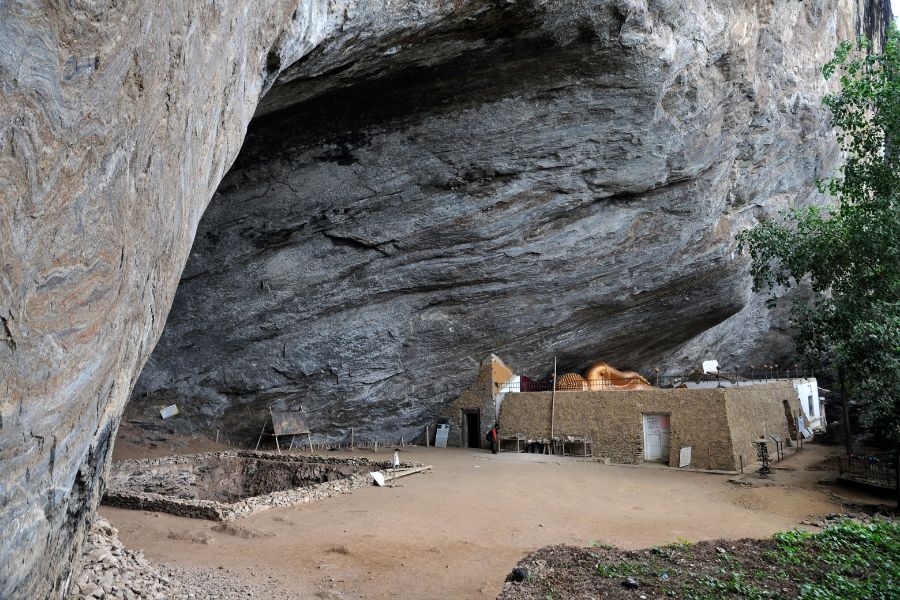
The Sleeping Giant: Location and Scale
Pahiyangala Cave is situated about 40 kilometres from Colombo, nestled within the village of Yatagampitiya, near Bulathsinhala in the Kalutara district. The journey to this hidden gem takes you through verdant countryside, passing rice fields and rural villages before you arrive at the base of a colossal rock formation.
The cave’s dimensions are staggering. It sits approximately 400 feet (122 metres) above sea level. The entrance is a massive semi-circle, measuring about 175 feet high and 160 feet wide. The cave extends about 282 feet in length, with its widest spot reaching 160 feet. Inside, some areas soar to over 400 feet in height.
To put this in perspective, the Pahiyangala Cave is about three times the size of the famous Dambulla Rock Cave in the Cultural Triangle. Its interior is so vast that it can safely accommodate up to 3,000 people at once during heavy rain or natural disasters.
A Window to Prehistory
The true significance of Pahiyangala Cave lies not in its size, but in what lies beneath its surface. Starting in 1956 and continuing through the 1980s, the Sri Lankan Department of Archaeology conducted extensive excavations at the site. What they found rewrote the history books.
The 37,000-Year-Old Skulls
The most remarkable discovery was a set of five human skulls. Carbon-14 dating conducted in the USA confirmed that these remains were approximately 37,000 years old. This finding provided concrete evidence that anatomically modern humans (Homo sapiens) had settled in Sri Lanka between 50,000 and 40,000 years ago.
In 2012, a full human skeleton of a woman, aged 18 to 30, was unearthed at the site, estimated to be about 30,000 years old. The excavation revealed an incredible 239 human settlement layers, offering a layered timeline of human occupation stretching from the Late Pleistocene through the Mesolithic period to the Neolithic era around 4,750 years ago.
Weapons and Tools
Archaeologists discovered a range of tools and weapons that paint a vivid picture of daily life for these ancient people. They found stone tools and weapons made from animal bones that were used to hunt monkeys, deer, and porcupines.
Perhaps the most groundbreaking find came from an international team of scientists from Germany, Australia, and Sri Lanka. During excavations between 2009 and 2012, they unearthed bone arrowheads that provide evidence for the earliest use of the bow and arrow outside of Africa, dating back approximately 45,000 to 48,000 years. This discovery placed Sri Lanka at the forefront of human technological innovation.
Diet and Daily Life
The diet of these prehistoric people was surprisingly varied. They consumed edible snails and wild breadfruit. After eating the snails, they would pierce the shells to create jewellery. This suggests not only a resourceful approach to food but also an early sense of aesthetics and personal adornment.
The Legend of Fa-Hien
The cave is known by two names: Pahiyangala and Fa-Hien Lena. The latter pays homage to the Chinese Buddhist monk Fa-Hien (Faxian), who travelled to Sri Lanka in the 5th century AD.
According to legend, Fa-Hien visited this cave during his two-year sojourn in Sri Lanka. He is believed to have stayed here for a short period on his way to Sri Pada (Adam’s Peak). Fa-Hien is famous for his pilgrimage to India and Sri Lanka, during which he brought back Buddhist scriptures and is credited with discovering several sacred sites.
Interestingly, some scholars note that this belief has not been definitively corroborated by historical records. However, the enduring legend has cemented the cave’s importance in the history of Han Buddhism in the world. The cave is also associated with Thaishu Sangaraju Thero during the 1940s.
A Sacred Space: The Buddhist Temple
Today, Pahiyangala Cave is more than an archaeological site – it is a living place of worship. A local monk, Ven. Poranagama Thero, used a heavy stone tool to clear the cave entrance and level the ground, transforming the base of the cave into a Buddhist temple.
Visitors are greeted by a remarkable 40-foot-long reclining Buddha statue that sits majestically within the cave chamber. The site is surrounded by approximately 600 acres of virgin forest, adding to the sense of tranquillity and timelessness.
The temple and the cave are maintained by resident monks, and it remains a popular destination for school trips and picnickers.
Visiting Pahiyangala Cave
For those adventurous enough to seek out this hidden gem, the journey is part of the experience.
How to Get There
-
By Private Vehicle: The fastest route from Colombo is to take the Southern Expressway (E1) from the Kottawa interchange and exit at Bandaragama. Then take the Bandaragama–Horana road to Bulathsinhala.
-
By Public Transport: Take a 120 bus from Colombo to Horana. From there, take the 285 bus (Horana–Mathugama) and get off at Bulathsinhala. Then hire a tuk-tuk for the remaining journey.
-
The Final Climb: From the parking area, visitors must climb a narrow and steep set of stairs through the jungle. The walk takes approximately 20 to 30 minutes. The steps are cemented but lack railings in places, so caution is advised.
What to Expect
-
Entry: Free. The site is open to the public and managed by the monks.
-
Time Required: Allow about 1 to 2 hours to explore the cave and temple.
-
Wildlife: On your way up, you are likely to see monkeys jumping from tree to tree, accompanying you to the cave base.
-
Facilities: Basic toilets are available. There is no food or drink available at the site, so bring your own supplies.
-
Best Time to Visit: The dry season from December to March is ideal.
The Unanswered Mysteries
Despite decades of research, Pahiyangala Cave still holds secrets. In 2020, a report raised questions about the whereabouts of some archaeological artefacts recovered from the site. The cave also has natural tunnels that remain blocked due to ongoing archaeological research.
There is also a persistent folk belief, though not scientifically substantiated, that the cave is home to an ancient giant skull. While this remains in the realm of local lore, it adds to the cave’s mystique.
Why Pahiyangala Matters
Pahiyangala Cave is a reminder that Sri Lanka’s history extends far beyond the Anuradhapura period or the Kandyan Kingdom. It connects the island to the dawn of human civilisation itself.
The discoveries here – the 37,000-year-old skulls, the 48,000-year-old bone arrowheads – place Sri Lanka on the global map of human evolution. They show that the island was not a remote backwater but a vibrant centre of human activity and innovation during the Stone Age.
For the traveller seeking something beyond the usual tourist trail, Pahiyangala Cave offers a profound encounter with the deep past. It is a place where you can stand in the same space where humans lived, hunted, and created art nearly 40,000 years ago.
Conclusion: The Secret Worth Finding
In a country famous for its ancient cities and UNESCO World Heritage Sites, Pahiyangala Cave remains one of Sri Lanka’s best-kept secrets. It is the largest cave in Asia, a prehistoric settlement that rewrites history, a sacred Buddhist temple, and a natural wonder all in one.
To climb its stone steps and stand in its vast chamber is to connect with something ancient and profound. It is to touch the very origins of human life in this part of the world.
Pahiyangala Cave is not just a destination. It is a journey back in time.
Reviews and Recommendations
Don't just take our word for it! Check out these incredible reviews from past travelers


Join thousands of satisfied travelers who discovered Sri Lanka with us
Read All ReviewsNeed Help Planning Your Trip?
Our travel experts are here to help you create the perfect Sri Lankan adventure
Call Us Directly
Speak with our travel specialists for personalized assistance
24/7 Hotline:
+94 77 791 1276
WhatsApp Us
Quick responses on WhatsApp for instant travel queries
Response Time:
Within 30 minutes
Email Us
Send us your requirements and we'll create a custom itinerary
Email:
[email protected]
Popular Journeys
Discover our most loved travel experiences
Related Experiences
Authentic local experiences you'll love
You Might Also Like
More travel inspiration from our blog
The 1869 Coffee Disaster That Gave the World Ceylon Tea
Sri Lanka’s ‘Flower Boys’ The Viral Tradition That’s Stealing Hearts Worldwide
We Didn’t See a Single Elephant, And It Was the Best Safari of My Life
Sri Lanka Family Holidays: The Ultimate Guide to the Most Kid-Friendly Destination in Asia
Frequently Asked Questions About Traveling in Sri Lanka
Everything you need to know about planning your Sri Lankan adventure, from visas and safety to food and transportation