Everything You Need to Know About Sri Lanka History: Ancient Kingdoms to Modern Nation
The History of Sri Lanka: From Ancient Kingdoms to Modern Nation Sri Lanka’s history is a chronicle of extraordinary depth—spanning over two millennia of documented civilization, marked by hydraulic engineering marvels, Buddhist scholarship, colonial contest, and a hard-won modern identity. For the luxury traveler exploring the island’s cultural triangle or tea country, understanding this layered …
The History of Sri Lanka: From Ancient Kingdoms to Modern Nation
Sri Lanka’s history is a chronicle of extraordinary depth—spanning over two millennia of documented civilization, marked by hydraulic engineering marvels, Buddhist scholarship, colonial contest, and a hard-won modern identity. For the luxury traveler exploring the island’s cultural triangle or tea country, understanding this layered past transforms ruins into stories and landscapes into living history.
The Ancient Heart: Anuradhapura and the Birth of Sinhalese Civilization
The island’s historical record begins in earnest with the arrival of Sinhalese settlers and the establishment of Anuradhapura as a great capital. By the third century BCE, Anuradhapura had become the ritual and administrative center of the island’s chief kings, a position it would hold for thirteen centuries . The city’s society flourished on a robust economy built around the control and distribution of water—a sophisticated irrigation system that supported one of the ancient world’s most remarkable urban centers .
The most striking feature of Anuradhapura was the symbiotic relationship between royalty and monastery. The massive stupas built by Anuradhapura kings—Ruvanvelisaya, Abhayagiriya, and Jetavana—were, at the time of their construction, the largest man-made structures in the world after the pyramids of Egypt . This was also the era when Theravada Buddhism took root, with monastic chronicles like the Dipavamsa and Mahavamsa composed in Pali, offering the earliest interpretive windows into Sri Lanka’s distant past .
The Mahavamsa itself preserves the founding myth of the Sinhalese people: the Indian prince Vijaya, grandson of a lion, arrived on the island and married Princess Kuveni. From their union was born the Sinhalese race—sinhala meaning “of lions”—and the lion became the mythical ancestor of kings and symbol of royal authority .
Sigiriya: The Lion Fortress and the Tragedy of King Kashyapa
No single monument captures Sri Lanka’s dramatic ancient history more vividly than Sigiriya. Rising 200 meters above the central plains, this rock citadel was built in just eighteen years by King Kashyapa I (477–495 CE), whose reign was marked by patricide, paranoia, and unprecedented architectural ambition .
Kashyapa seized the throne by murdering his father, King Dhatusena, and feared retribution from his exiled half-brother Moggallana. He abandoned Anuradhapura and transformed Sigiriya into an impregnable fortress-palace, conceived as both a military stronghold and a representation of Mount Meru, the cosmic mountain at the center of Buddhist and Hindu cosmology—positioning himself as a god-king . The complex included water gardens with hydraulic systems still partially functional after fifteen centuries, boulder gardens with meditation platforms, and the famous frescoes of the “Sigiriya Maidens”—celestial figures of remarkable naturalism, of which only twenty-two survive today .
The Mirror Wall, originally polished to gleam like glass, bears over 1,800 inscriptions scratched by visitors between the 6th and 14th centuries—ancient graffiti offering a unique window into medieval literary culture . The ascent culminated at the Lion’s Gate, a monumental gateway shaped as a giant lion, through whose paws visitors passed to reach the summit palace .
Kashyapa’s story ended in defeat. When Moggallana returned with an army in 495 CE, Kashyapa took his own life. Sigiriya was donated to the Buddhist monastic order and functioned as a monastery until the 14th century before being reclaimed by jungle—only to be rediscovered by British archaeologists in the 19th century .
Polonnaruwa: The Second Kingdom and Artistic Zenith
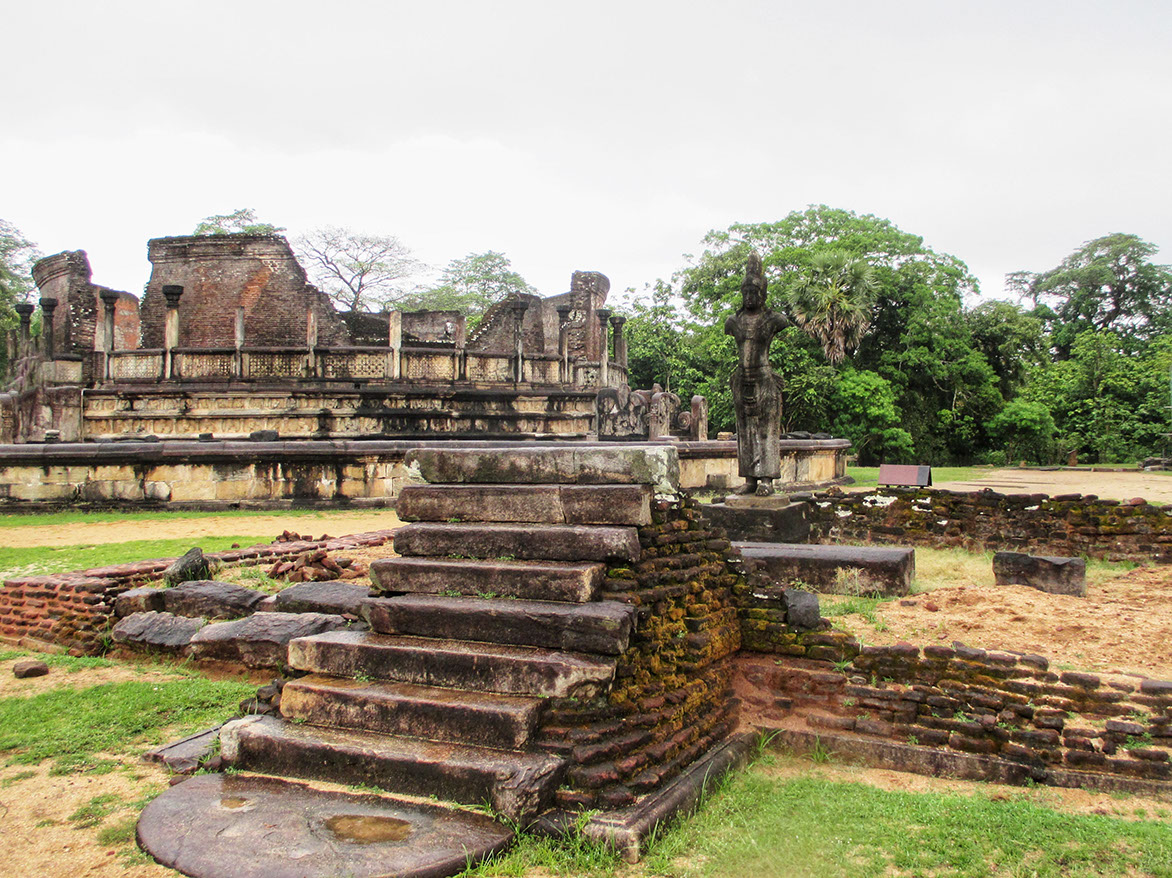
When Anuradhapura’s infrastructure was destroyed by South Indian Cola invaders in the early 11th century, Polonnaruwa rose as the island’s new capital . It served as the center of Chola administration for over seventy years before becoming the seat of the second Sinhalese kingdom under King Vijayabahu I . The city reached its zenith under King Parakramabahu the Great (1153–86) and Nissankamalla (1187–96), who oversaw a remarkable flourishing of Buddhist art and architecture .
Polonnaruwa’s legacy includes the Gal Vihara, colossal rock-cut Buddha images considered the most celebrated site in the city, and the Vatadage, a circular stupa-shrine whose stone carvings and slender pillars represent the graceful beauty of medieval Sinhalese craftsmanship . The Palace of King Parakramabahu, a seven-storied structure that once contained a thousand rooms, remains the best surviving example of ancient royal architecture—Sigiriya’s palace foundations being too eroded to visualize what a royal abode truly looked like . Hindu influence is evident throughout Polonnaruwa, with Siva Devale shrines and ornate carvings reflecting South Indian aesthetic traditions, born of the close cultural exchange between the island and the subcontinent .
By the mid-13th century, Polonnaruwa succumbed to foreign invasions and political turmoil, gradually abandoned and forgotten until its rediscovery by a British military officer in the early 19th century .
The Colonial Era: Portuguese, Dutch, and British
Sri Lanka’s position in the Indian Ocean made it vulnerable to European expansion. By the mid-1500s, the Portuguese had exploited dynastic tensions among the island’s ruling elite and controlled much of the island. A century later, the Dutch replaced them, and by the late 1700s the British had displaced the Dutch in turn .
The Kingdom of Kandy, founded in the late 15th century in the central highlands, remained the sole independent native polity from the 1590s onward. Through a combination of guerrilla tactics and diplomacy, Kandy kept European colonial forces at bay for centuries, allying variously with the Jaffna Kingdom, Sitawaka, the Portuguese, and the Dutch to ensure its survival . But the kingdom suffered from continuous political tension in the late 18th century, and certain nobles intrigued with colonial powers. The British formally unified the island under their flag in 1815 through the Kandyan Convention, absorbing Kandy as a protectorate . The Uva Rebellion of 1817 definitively ended Kandyan autonomy .
British rule brought scholars like George Turnour, who worked with a Buddhist monk to translate the Mahavamsa into English and identified the ancient capitals of Anuradhapura and Polonnaruwa from its chronicles—setting the stage for the archaeological rediscovery of Sri Lanka’s ancient past .
Tea: The Crop That Saved a Colony
The early 1880s were a lean time in Ceylon. The colonial economy had been built almost entirely on coffee, and when a fungal blight destroyed the coffee enterprise, the economy collapsed. Plantations were sold for a song; banks faced runs; frantic experiments with indigo and cinchona failed .
Salvation came from an unlikely source: a reclusive Scots planter named James Taylor, who had been experimenting with tea on his coffee estate at Loolecondera. By the time the coffee blight struck, Taylor had twenty acres planted in tea and had shipped his first modest consignment—23 pounds—to England. Soon planters from across the hill country visited Loolecondera to learn how to grow and manufacture tea . More than 120,000 hectares of dead coffee bushes were stripped and replanted in tea. Sir Arthur Conan Doyle later wrote that “the tea-fields of Ceylon are as true a monument to courage as is the lion at Waterloo” . Within a decade, a new plantation enterprise had been built on the ruins of the old, and the colony was prosperous again.
Tea remains central to Sri Lanka’s identity and economy. The hill country estates where travelers now stay in restored planters’ bungalows—Ceylon Tea Trails among them—are the direct legacy of Taylor’s experiment .
Independence and Modern Sri Lanka
Ceylon became independent in 1948, and the name was changed to Sri Lanka in 1972 . The post-independence era was marked by political tensions, including a South Indian Tamil kingdom established in the north in the 14th century whose legacy contributed to later ethnic complexities . By May 2009, the government announced that its military had defeated the remnants of the LTTE, ending a decades-long conflict .
Today, Sri Lanka stands as a nation where ancient hydraulic civilizations, colonial tea estates, and modern hospitality coexist. For the VVIP traveler, this history is not merely context—it is the foundation of every experience, from the frescoes of Sigiriya to the bungalow verandas of Hatton. The island’s past is present in its ruins, its tea, and its enduring spirit.
Contact Us Today!
Ready to plan your dream journey in Sri Lanka? Let us help you craft the perfect itinerary for a truly memorable experience.
Contact Rediscover Sri Lanka to explore our tailor-made journeys, private tours and authentic Sri Lankan experiences.
Begin a ConversationReviews and Recommendations.
Don't just take our word for it! Check out these incredible reviews from past travellers.
Read about other travellers' experiences and explore reviews of our parent company.
Read ReviewsDiscover feedback from travellers who have experienced Rediscover Journeys and explored Sri Lanka with our team.
Read ReviewsBook Your Adventure.
Ready to experience Sri Lanka beyond the usual tourist trail? Let us create a private journey around your interests, pace and travel style.
Ready to Rediscover Sri Lanka?
Plan your trip with Rediscover Sri Lanka and create unforgettable memories at some of the island's most extraordinary places.
Visit Rediscover Sri Lanka to start planning your journey.
Curate Your JourneyEverything you need to know about travelling in Sri Lanka.
Sri Lanka is a year-round destination, with the best time to visit depending on the regions you plan to explore. The west and south coasts are generally best from December to April, while the east coast is ideal from May to September. The central highlands offer cooler weather and scenic landscapes throughout much of the year.
A journey of 7 to 14 days allows you to experience many of Sri Lanka’s highlights at a comfortable pace. You can combine ancient cultural sites, wildlife safaris, scenic train journeys, tea country, and tropical beaches. A longer stay gives you more time to discover hidden gems and enjoy meaningful local experiences.
Sri Lanka offers a remarkable variety of destinations, from the ancient cities of Sigiriya and Polonnaruwa to the misty hills of Ella and Nuwara Eliya. Wildlife enthusiasts can explore Yala and Udawalawe National Parks, while the southern coast offers beautiful beaches and historic Galle Fort. The best places to visit depend on your interests, travel dates, and preferred pace.
Absolutely. Sri Lanka is home to diverse ecosystems, national parks, rainforests, wetlands, and mountain landscapes. Visitors can look for elephants, leopards, and a wide variety of birdlife on guided wildlife safaris, explore lush nature trails, or discover marine life along the coast. Responsible travel and following local wildlife guidelines help protect these natural environments.
Travellers can discover centuries-old temples, ancient kingdoms, traditional arts and crafts, vibrant festivals, and the island’s rich culinary heritage. Experiences may include visiting local markets, learning about traditional cooking, exploring historic landmarks, or meeting local communities. These encounters offer a deeper understanding of Sri Lanka’s traditions, people, and way of life.
Before travelling, consider the seasonal weather, regional travel times, local customs, appropriate clothing for religious sites, and entry requirements for your nationality. Sri Lanka’s landscapes and road conditions can make journeys longer than expected, so allowing time between destinations is worthwhile. Planning ahead helps you enjoy a more comfortable and rewarding experience.
The official currency is the Sri Lankan Rupee (LKR). Cards are accepted at many hotels, restaurants, and larger businesses, while cash is useful for local shops, markets, and smaller establishments. It is helpful to carry some local currency and check current exchange rates before your trip.
Yes. Sri Lanka offers experiences for a wide range of travellers, including families, couples, solo explorers, and groups of friends. Families can enjoy wildlife safaris, cultural discoveries, and relaxed beach stays, while couples may prefer scenic retreats, boutique hotels, and private experiences. An itinerary tailored to your interests can help create a more enjoyable journey.