Everything You Need to Know About Sri Lanka Travel Guide 2026: Weather, Monsoon Season & Hidden Gems
Sri Lanka Travel Guide 2026: Weather, Monsoon Season & Hidden Gems Plan your 2026 Sri Lanka trip with our expert guide. Learn about the monsoon season, El Niño impact, and discover hidden gems. Start your journey today! Introduction: Why Sri Lanka in 2026? Sri Lanka doesn’t ease you in. The moment you land in Colombo, …
Sri Lanka Travel Guide 2026: Weather, Monsoon Season & Hidden Gems
Plan your 2026 Sri Lanka trip with our expert guide. Learn about the monsoon season, El Niño impact, and discover hidden gems. Start your journey today!
Introduction: Why Sri Lanka in 2026?
Sri Lanka doesn’t ease you in. The moment you land in Colombo, the island throws everything at you at once — the scent of cinnamon drifting from a spice market, tuk-tuks weaving through traffic like they invented physics, and a sky so relentlessly blue it looks photoshopped . This teardrop-shaped island packs more per square mile than almost anywhere else on earth: ancient temples, working tea plantations, jungle-draped wildlife reserves, surf beaches, and one of the friendliest travel cultures you’ll encounter in Asia.
Sri Lanka’s tourism has rebounded strongly after years of economic turbulence. Prices remain excellent compared to Southeast Asian tourist hubs, infrastructure has improved significantly with new expressways cutting travel times, and overtourism hasn’t hit the way it has in Bali or Thailand’s main islands . You still get authentic interactions and uncrowded temple complexes — for now.
The country is also remarkably compact. You can do beaches, wildlife, tea country, and culture in two weeks without feeling rushed . 2026 brings an extra layer of complexity: a super El Niño is forecast to peak during the island’s busiest travel months, with effects capable of persisting into February 2027 . But with the right planning, Sri Lanka remains a year-round destination — you just need to pick the right coast for the season.
Sri Lanka’s Two Monsoon Seasons Explained
Unlike most tropical destinations with a single wet season, Sri Lanka has two monsoons hitting opposite sides of the island at opposite times of year . That means there is always somewhere with good weather, but you have to plan around it.
The Two Monsoons
-
Southwest (Yala) Monsoon: ~May to September — wets the south coast, west coast, and hill country
-
Northeast (Maha) Monsoon: ~October to January — wets the east coast, the north, and more mildly, the Cultural Triangle
The critical insight: when the west is wet, the east is dry — and vice versa . Sri Lanka is a year-round destination if you’re flexible about which coast you visit.
Month-by-Month Guide
| Period | West & South Coast | East Coast | Hill Country |
|---|---|---|---|
| December – March | ✅ Best | ❌ Rainy | ✅ Cool & dry |
| April | ✅ Shoulder | ✅ Best | ✅ Good |
| May – July | 🌧️ SW Monsoon | ✅ Best | 🌧️ Some rain |
| August – September | 🌧️ SW Monsoon | ✅ Best | 🌧️ Some rain |
| October – November | 🌧️ Transitional | 🌧️ Transitional | 🌧️ Some rain |
Month-by-Month Breakdown
-
December – March: Peak season for the south & west coast, Galle, the hills, and the Cultural Triangle. Sunniest, busiest, priciest. The classic window . Whale watching peaks November–April .
-
January: Finest month island-wide. Cool hill country, calm seas, vibrant beaches .
-
February: Excellent. Whale watching at its peak off Mirissa .
-
March: Still excellent on the west/south. Hill country perfect .
-
April: Shoulder month. First two weeks fine; late April sees the southwest monsoon approach. Sinhala/Tamil New Year (mid-April) is a big, festive deal .
-
May – July: Southwest monsoon. West coast, south coast, and Colombo are wetter. East coast (Trincomalee, Arugam Bay) is DRY and excellent . Surfing season begins at Arugam Bay.
-
August – September: East coast at its best — Trincomalee beaches pristine, Pigeon Island clear. Minneriya Elephant Gathering peaks (August–October) . Kandy Esala Perahera (July/August full moon) — Sri Lanka’s greatest festival .
-
October: Shoulder season. East coast winds down; north-east monsoon approaches. Ancient cities (Anuradhapura, Polonnaruwa) still good. West coast starts drying out .
-
November: North-east monsoon peaks on the east/north. Whale watching season begins (Mirissa) .
The 2026 El Niño Factor
Sri Lanka’s tourism authorities are working with wildlife, irrigation and provincial agencies on a set of measures to hold the visitor experience steady through a super El Niño forecast to peak in the island’s busiest travel months .
The Department of Meteorology has placed a 69 percent probability on the developing event becoming stronger than any experienced in the past 75 years, while the US National Oceanic and Atmospheric Administration puts the chance of a strong El Niño forming during October-December at 81 percent .
What This Means for Your Trip
Forecasts point to below-normal rainfall across parts of the Northern, North Central, Eastern and Uva regions, with heavier rain possible elsewhere later in the season .
The SLTDA’s revised growth scenarios state that adverse weather associated with El Niño adds “another layer of uncertainty to the tourism outlook”, given that extreme weather can disrupt transport, affect coastal and nature-based attractions and shape visitor perceptions of destination safety .
Practical Adjustments
-
Be flexible: If Yala’s main blocks are closed due to drought (as happened in September–October 2026), consider alternatives like Maduru Oya National Park, which spans more than 58,800 hectares and holds close to 150 elephants, alongside sloth bear, leopard and over 100 bird species .
-
Book with operators who offer flexibility: The SLTDA is working on directing traffic to less crowded parks to relieve overtourism pressure at Yala and Wilpattu .
-
Travel insurance: Ensure your policy covers weather-related disruptions.
Where to Go: The Core Circuit
Most first-time visitors follow a rough circuit that loops through the cultural triangle, hill country, and southern coast .
Colombo (1–2 days)
The capital gets dismissed too often. Spend a half-day in Pettah market’s sensory chaos, have dinner in the Galle Face Hotel’s oceanfront bar, and walk the Colombo 7 neighborhood’s tree-lined streets. Don’t overdo it — there’s a whole island waiting .
Sigiriya & Dambulla (2 days)
Sigiriya Rock Fortress is the image you’ve seen — a 5th-century palace carved into a vertical granite column rising 200 meters from flat jungle. The climb takes about 90 minutes and involves some narrow stairways (not for severe vertigo), but the views and the frescoes of celestial maidens painted on the rockface make it one of the most extraordinary archaeological sites in Asia. Entry: ~$30 USD for foreign visitors .
Twenty minutes away, Dambulla’s cave temples contain 150 Buddha statues spread across five cave sanctuaries, some dating to the 1st century BC .
Kandy (2 days)
Sri Lanka’s last royal capital sits around an artificial lake in the highlands. The Temple of the Tooth Relic (Dalada Maligawa) houses what believers consider the Buddha’s tooth — expect crowds, puja ceremonies at 6:30 AM and 9:30 PM, and vendors selling jasmine garlands outside . Kandy is also your gateway to tea country.
Ella & the Hill Country (2–3 days)
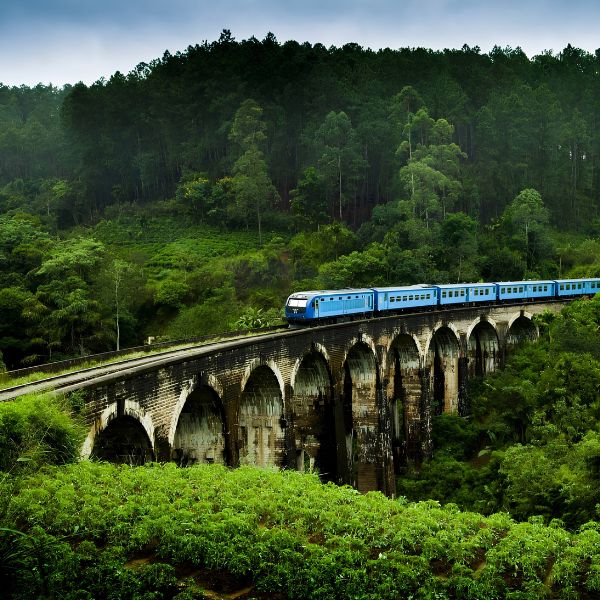
The train from Kandy to Ella (via Nanuoya for Nuwara Eliya) is consistently ranked among the world’s most scenic rail journeys . The slow blue train climbs through emerald tea plantations, past waterfalls and misty ridgelines, doors open, travellers’ legs dangling from the carriage in the iconic shot .
Practical tips: Book a reserved seat in advance for the popular Kandy-to-Ella or Nanu Oya-to-Ella stretch, especially in high season, or you’ll stand for hours . The full Kandy-to-Ella run takes around seven hours, and many people do just the most scenic three-hour section from Nuwara Eliya . Near Ella, the Nine Arches Bridge, a colonial-era viaduct curving through jungle, is the spot to watch a train cross .
The South Coast
Galle Fort — a UNESCO World Heritage Site with well-preserved fort walls, cobblestone streets, and colonial-era buildings .
Mirissa — whale watching capital, best November–April .
Unawatuna — a lively beach with easy access to Jungle Beach, a hidden cove reached via a 10-15 minute jungle trail . The trail passes ancient Buddhist ruins — dress modestly and be respectful .
Sri Lanka’s Hidden Gems for 2026
Jaffna — The North’s Cultural Revival
Jaffna, in the north, had a longstanding association with conflict, making people wary of considering the area safe. However, today “it stands as one of the most rewarding places to visit” . Named as one of the top 25 destinations to visit in 2026 by Lonely Planet, Jaffna offers a calmer and authentic experience compared to the busier cities in the south .
What to see: The Jaffna Public Library, a “cultural gem nestled in the heart of the historic city of Jaffna” ; Casuarina Beach, considered one of the most beautiful beaches in the region ; and Northern Sri Lankan cuisine, known for its bold flavours, local spices and emphasis on fresh produce and seafood .
Kalpitiya — Kitesurfing Paradise
Kalpitiya is a thin finger of land on the northwestern coast, about 170 kilometres from Colombo, with a geography so generous it almost feels rigged: the open Indian Ocean on one side, a vast shallow lagoon on the other, and a strip of sand and scrub between them where the wind blows steady and true for most of the year .
What to do: Kitesurfing (May–October for the best wind; November–April for gentle conditions) ; snorkelling and diving at Bar Reef, one of Sri Lanka’s largest coral systems ; and dolphin trips in season where huge pods of spinner dolphins leap in the early light .
Mulgirigala Raja Maha Viharaya — Sigiriya’s Little Brother
This ancient Buddhist temple complex is hidden among the rocks and greenery of southern Sri Lanka. To reach the top, you need to climb a staircase through several levels of cave temples, where Buddha statues, frescoes, and paintings have been preserved. At the top, a truly unique view opens up: dense green forests and hills .
Entrance: Free. Unlike Sigiriya, there were practically no people here .
What to Eat
Sri Lankan food is its own thing — spicier, more coconut-driven, and more distinct from “Indian” than visitors expect — and it’s some of the best value eating on the planet .
-
Rice & curry — the national lunch and dinner: a mound of rice ringed by five to a dozen little curries .
-
Hoppers (appa) — bowl-shaped, crispy-edged pancakes of fermented rice-flour-and-coconut batter. The egg hopper is the classic breakfast .
-
Kottu roti — the sound of Sri Lankan evenings: shredded godhamba flatbread chopped and stir-fried on a hot griddle .
-
Pol sambol & lunu miris — fiery grated-coconut and chilli-onion relishes that go with everything .
-
Ceylon tea — non-negotiable. Sri Lanka is one of the world’s great tea producers .
Getting Around
-
Private driver-guide — the standard, and the right call for most. Roughly €45–€85 a day for a sedan; you set the pace. Vet for English and reviews, agree the itinerary and daily rate up front .
-
Trains — slow, cheap, and scenic, the hill-country line above all. Great for the experience on key stretches; impractical as your only transport .
-
Tuk-tuks — perfect for short hops and town-hopping. Use the PickMe app (the local leader) .
-
Buses — frequent and cheap but can be crowded and slow .
Practical Tips
Visa: Most nationalities require a tourist ETA (Electronic Travel Authorization). Apply online before arrival.
Currency: Sri Lankan Rupee (LKR). ATMs widely available in cities and tourist areas.
What to pack: Light, breathable clothing for the coast, warmer layers for the hill country (Nuwara Eliya, Ella), modest clothing for temple visits (shoulders and knees covered) , comfortable walking shoes, swimwear, sunscreen, and insect repellent. A rain jacket if visiting during monsoon months.
Safety: Sri Lanka is generally safe for tourists. Exercise normal precautions and follow local advice.
Health: Drink bottled water. Protect against mosquitoes.
Phrasebook: Ayubowan (hello/welcome), Istuti (thank you).
Conclusion: Your Sri Lanka Adventure Awaits
Sri Lanka delivers a remarkable diversity of experiences within a manageable travel radius. Whether you’re climbing Sigiriya’s ancient rock fortress, spotting leopards in Yala, sipping Ceylon tea in the misty hills, or watching the sunset over Galle Fort, the Pearl of the Indian Ocean offers experiences that will stay with you forever.
The key to a successful 2026 trip is timing — choose the right coast for the season, stay flexible with the El Niño forecast, and don’t be afraid to explore beyond the well-trodden path. Jaffna, Kalpitiya, and hidden temples like Mulgirigala are waiting to be discovered.
Start planning your Sri Lanka adventure today — the Pearl of the Indian Ocean is calling!
Book Your Adventure
Ready to experience this coastal paradise? Plan your trip with Rediscover Sri Lanka and create unforgettable memories at Hiriketiya Beach.
📩 Visit: Rediscover Sri Lanka to book now.
Contact Us Today!
Ready to plan your dream group tour in Sri Lanka? Let us help you craft the perfect itinerary for a truly magical experience.
👉 Contact Rediscover Sri Lanka now to explore our Sri Lanka group tour packages, designed for families, solo travelers, and adventure seekers alike.
Reviews and Recommendations
Don’t just take our word for it! Check out these incredible reviews from past travelers:
Tripadvisor: Read about other travelers’ experiences on Tripadvisor, where Rediscover Sri Lanka has garnered rave reviews for its safe and well-organized tours.
Trustpilot: Visit Trustpilot for more real-life testimonials from travelers who have fallen in love with Sri Lanka’s beauty and hospitality.
Contact Us Today!
Ready to plan your dream journey in Sri Lanka? Let us help you craft the perfect itinerary for a truly memorable experience.
Contact Rediscover Sri Lanka to explore our tailor-made journeys, private tours and authentic Sri Lankan experiences.
Contact UsReviews and Recommendations.
Don't just take our word for it! Check out these incredible reviews from past travelers.
Read about other travelers' experiences with Rediscover Sri Lanka and explore reviews from guests who have travelled across the island.
Read ReviewsDiscover feedback from travelers who have experienced Rediscover Journeys and explored Sri Lanka with our team.
Read ReviewsBook Your Adventure.
Ready to experience Sri Lanka beyond the usual tourist trail? Let us create a private journey around your interests, pace and travel style.
Ready to Rediscover Sri Lanka?
Plan your trip with Rediscover Sri Lanka and create unforgettable memories at some of the island's most extraordinary places.
Visit Rediscover Sri Lanka to start planning your journey.
Plan Your JourneyEverything you need to know about traveling in Sri Lanka.
Sri Lanka is a year-round destination, but the best time depends on which part of the island you plan to explore. The west and south coasts are generally best from December to April, while the east coast is ideal from May to September.
Around 7 to 14 days is a good amount of time to experience Sri Lanka's highlights without rushing. A longer journey allows more time for wildlife, beaches, cultural sites, scenic train journeys and the hill country.
Most international travellers need travel authorisation or a visa to enter Sri Lanka, depending on their nationality and purpose of travel. Travellers should check the latest requirements through official Sri Lankan government channels before travelling.
Sri Lanka is a popular destination for international travellers. As with any destination, visitors should take normal precautions, look after their belongings, use reputable transport and follow local advice.
The official currency is the Sri Lankan Rupee (LKR). Your budget depends on accommodation, transportation, dining, activities and travel style. Sri Lanka offers everything from budget-friendly experiences to premium hotels and tailor-made luxury travel.