
Everything You Need to Know About Sri Lanka Responsible Travel: Ethical Guide 2026
Sri Lanka Responsible Travel: The Complete Guide (2026) Responsible travel in Sri Lanka means three things: choosing community-owned experiences over staged tourism, refusing to touch or ride wildlife, and carrying your own waste out of the places you visit. The island’s official tourism authority publishes clear “Golden Rules” — take all garbage home, dress modestly …
Sri Lanka Responsible Travel: The Complete Guide (2026)
Responsible travel in Sri Lanka means three things: choosing community-owned experiences over staged tourism, refusing to touch or ride wildlife, and carrying your own waste out of the places you visit. The island’s official tourism authority publishes clear “Golden Rules” — take all garbage home, dress modestly at temples, and never turn your back to a Buddha statue for a selfie . Beyond etiquette, a new wave of community-led projects, government regulations, and ethical wildlife alternatives is making it easier than ever to travel well.
For responsible travel in Sri Lanka, stay in community homestays, take the train instead of domestic flights, avoid elephant riding and turtle touching, carry a reusable water bottle (single-use plastic bottles are banned in state institutions from May 2026), and book through licensed operators who pay local hosts fairly.
Quick Answer: Responsible Travel Choices in Sri Lanka
| Choice | Responsible Option | Avoid |
|---|---|---|
| Wildlife | Udawalawe Elephant Transit Home (observation only) , Rekawa turtle watch | Elephant riding, Pinnawala, touching turtles |
| Accommodation | Community homestays (Blue Mountains View, Delft Village Stay), eco-lodges | Large resort compounds with no local benefit |
| Transport | Kandy–Ella train, PickMe tuk-tuks, private driver-guide | Domestic flights for short routes |
| Plastic | Reusable water bottle, carry your litter home | Single-use plastic bottles (banned in state offices from May 31, 2026) |
| Crafts | Locally handmade goods, village enterprises | Souvenirs made from protected species |
| Culture | Modest dress, remove shoes at temples, ask before photographing | Selfies with your back to Buddha statues |
What is responsible travel in Sri Lanka? Choosing community-owned experiences, refusing to touch or ride wildlife, carrying your own waste, and respecting temple etiquette — as outlined in Sri Lanka Tourism’s official Golden Rules.
The Official Golden Rules: What Sri Lanka Tourism Asks of You
Sri Lanka Tourism publishes a short list of “Golden Rules of Sensitive Travel” that every visitor should read before arriving. These are not suggestions — they are the baseline for travelling in a way that protects the island .
Do Not Litter — Take ALL Your Garbage Home
“Keep a ‘shopping bag’ with you and put ALL your litter (including bio-degradable garbage) in it. At the end of the day, dispose of it in your guest house, or take it home” .
The rules are explicit: do not leave garbage along roadsides, picnic spots, or bathing places. This matters especially in forests, nature reserves, and villages where waste collection is limited.
Be Respectful, Be Civilised
“In a place of worship, in a forest, in a village, in an ancient place… behave with respect. A civilised person is sensitive to others in terms of noise, words, behaviour, and dress” .
Key prohibitions:
-
No smoking or alcohol in public spaces (punishable by law)
-
No scratching names on ancient sites
-
No standing on ancient walls or moving stones
-
Ask permission before photographing people near shrines
In Forests and Nature Reserves
“Take only memories and photos. Do not speed in vehicles, do not drive off the trail. Keep quiet, listen to the sounds of nature” .
At Temples and Sacred Sites
-
Remove footwear before entering
-
Cover legs and shoulders
-
Do not take selfies with your back to Buddha statues
-
If monks are seated, sit lower or on the floor
-
Do not sit on white-sheeted seats reserved for monks
What are Sri Lanka’s Golden Rules for tourists? Take all garbage home, behave respectfully at sacred sites, do not smoke or drink in public, and never turn your back to a Buddha statue for a photo.
Plastic and Waste: The New Rules
Sri Lanka is tightening its plastic regulations, and travellers should plan accordingly.
| Regulation | Date | What It Means for Travellers |
|---|---|---|
| Single-use plastic water bottles banned in all state institutions | May 31, 2026 | Bring a reusable bottle; expect filtered water refills at hotels |
| Retailers forbidden from providing free plastic shopping bags | November 1, 2025 | Carry a tote bag for shopping |
| Plastic waste generation | 250,000–500,000 tonnes annually | Your choices matter |
Practical response: Carry a reusable water bottle and a cloth shopping bag. Ask your hotel whether they provide filtered water refills. Avoid buying bottled water where refills are available.
Is single-use plastic banned in Sri Lanka? Single-use plastic water bottles are banned in state institutions from May 31, 2026, and free plastic shopping bags were banned in retail from November 1, 2025.
Ethical Wildlife: What to Do and What to Avoid
Wildlife tourism is where responsible travel matters most — and where the difference between ethical and exploitative is stark.
Do: Udawalawe Elephant Transit Home
The Elephant Transit Home near Udawalawe is the ethical alternative to elephant riding and staged shows. It is not a zoo and not a show: orphaned baby elephants are rehabilitated and released into the wild. Visitors observe from a distance during feeding times (9am, 12pm, 3pm, 6pm). No touching, no feeding, no riding .
| Detail | Information |
|---|---|
| Location | Near Udawalawe National Park |
| Focus | Rehabilitation and release into the wild |
| Visitor experience | Observe from a distance, 30–45 minutes |
| Ethical standard | No riding, no touching, no forced interaction |
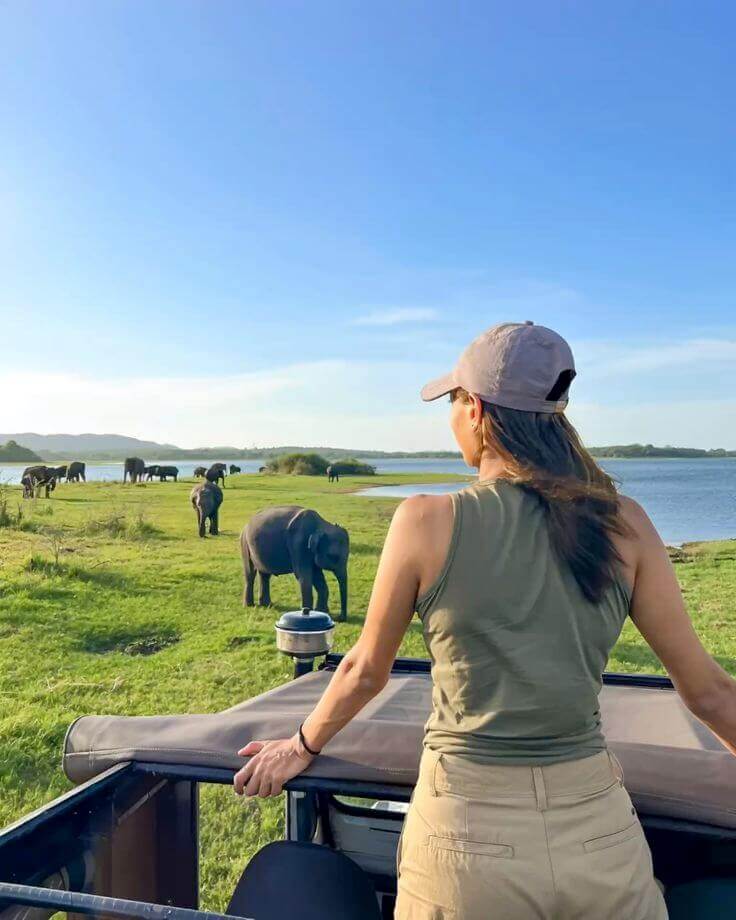
Do: Ethical Safaris (Minneriya, Kaudulla, Hurulu)
A GetYourGuide-listed safari explicitly frames its approach as “patience and respect” — observing elephants calmly from a safe distance, learning about family behaviour, and not rushing behind animals for photos . The best park changes by season and elephant movement; your guide should recommend honestly.
Don’t: Elephant Riding and Staged Encounters
Lonely Planet is direct: do not touch turtles coming out of the sea, and do not go whale watching — the blue whale population along the south coast has declined, and boats chasing the remaining whales worsen the issue .
What to avoid:
-
Elephant riding and bathing experiences
-
Pinnawala Elephant Orphanage (crowds, welfare concerns)
-
Commercial turtle hatcheries (tanks, handling)
-
Whale watching boats chasing depleted populations
What is the most ethical wildlife experience in Sri Lanka? The Udawalawe Elephant Transit Home for observation-only elephant rehabilitation, and Rekawa Beach for community-led turtle watching.
Community Tourism: Where Your Money Goes
Responsible travel means choosing experiences where the community benefits directly — not just the operator.
Galenbiduna Wewa (Anuradhapura)
A youth-led community organisation turned fishing boats into tour boats. Supported by UNDP, IUCN, the Ministry of Environment, and Rajarata University, the project offers boat safaris, elephant spotting, bird watching, and kayaking. The Ministry of Tourism trained members in kayaking and supplied kayaks to replace fishing dinghies .
| Detail | Information |
|---|---|
| Location | Upper Malwathu landscape, Anuradhapura District |
| Led by | Local youth organisation “Galenbiduna Wewa Api” |
| Support | UNDP, IUCN, Ministry of Environment, Rajarata University |
| Activities | Boat tours, elephant spotting, bird watching, kayaking |
Madampa Lake (Coconut Fibre Craft)
Swarnna, a traditional coconut fibre yarn maker, now welcomes visitors to her home-based workspace. Part of her income supports mangrove restoration through the Nagenahiru Foundation. The Living Lakes Biodiversity and Climate Project supports the initiative .
| Detail | Information |
|---|---|
| Location | Madampa Lake Wildlife Sanctuary |
| Craft | Coconut fibre yarn making (soaking, beating, drying, spinning) |
| Conservation link | Income supports mangrove restoration |
Blue Mountains View (Dambulla)
A farm-based homestay rated above local luxury hotels. Guests cook with the owner’s mother, tour the farm, and stay like family. The academic research on this homestay found that “authentic family-oriented, meaningful encounter with hosts” drove satisfaction above staged performances .
How can I support local communities in Sri Lanka? Choose youth-led projects like Galenbiduna Wewa, buy directly from village craft makers like Swarnna at Madampa Lake, and stay in family homestays like Blue Mountains View.
Government and Institutional Support for Responsible Tourism
Responsible tourism is not just a traveller choice — it is being built into national policy.
| Initiative | What It Does | Source |
|---|---|---|
| ADB-funded Dambulla-Sigiriya project | USD 30 million for climate-resilient, accessible, inclusive tourism; 11km Heritage Trail | Government News Portal |
| World Bank THRIVE Nature project | USD 1 million grant to prepare nature-based tourism project | Cabinet Office |
| Prime Minister’s eco-tourism focus | Target of 4 million tourists and USD 8 billion by 2030, with benefits reaching village entrepreneurs | Government News Portal |
| Smart Tourism Platform | Launched for Alawala community-based tourism village | Government News Portal |
What this means for travellers: The infrastructure and policy environment for responsible tourism is improving. Community-led experiences are becoming easier to find and better supported.
A Responsible Travel Itinerary (10 Days)
| Day | Location | Responsible Choice |
|---|---|---|
| 1 | Colombo | Arrival; use PickMe tuk-tuk, eat street food |
| 2–3 | Dambulla / Sigiriya | Blue Mountains View homestay; farm tour, cooking with host’s mother |
| 4 | Anuradhapura | Galenbiduna Wewa boat safari (youth-led) |
| 5–6 | Kandy / Tea Country | Train to Ella; Pekoe Trail section hike |
| 7–8 | Udawalawe | Elephant Transit Home (observation only) ; ethical safari |
| 9–10 | South Coast | Rekawa turtle watch (community-led); reusable bottle, carry litter |
responsible Sri Lanka itinerary, ethical Sri Lanka travel, Sri Lanka community tourism
Frequently Asked Questions
What is responsible travel in Sri Lanka?
Choosing community-owned experiences, refusing to touch or ride wildlife, carrying your own waste, and respecting temple etiquette.
Is elephant riding ethical in Sri Lanka?
No — choose observation-only experiences like the Udawalawe Elephant Transit Home instead .
Can I touch turtles in Sri Lanka?
No — Lonely Planet explicitly advises against touching turtles coming out of the sea .
Is whale watching responsible in Sri Lanka?
Lonely Planet recommends avoiding it — the blue whale population has declined and boats chasing them worsen the issue .
Is single-use plastic banned in Sri Lanka?
Single-use plastic water bottles are banned in state institutions from May 31, 2026 .
What are Sri Lanka’s Golden Rules for tourists?
Take all garbage home, behave respectfully at sacred sites, no smoking or alcohol in public, and never turn your back to a Buddha statue for a photo .
Where can I support community tourism?
Galenbiduna Wewa (youth-led boat safaris) , Madampa Lake (coconut fibre craft) , and Blue Mountains View homestay.
What should I wear at temples?
Shoulders and knees covered; remove shoes before entering .
How do I avoid plastic waste in Sri Lanka?
Carry a reusable water bottle and cloth shopping bag; ask hotels about filtered water refills .
Is the Kandy–Ella train responsible?
Yes — it is low-carbon and one of the world’s most scenic rail journeys .
Travel Responsibly With Rediscover Journeys
Ready to travel in a way that benefits Sri Lanka’s communities and wildlife? Contact Rediscover Journeys — we work with community hosts, ethical wildlife projects, and locally owned properties.
Speak to our team: +94 77 791 1276 (Rasith Gunaratna) · +94 77 887 8723 (Lakshan Surekha) · +94 11 226 0407 (Office) · [email protected]
Explore more:
-
Sri Lanka Community Tourism — projects and homestays
-
Sri Lanka Authentic Travel — beyond staged experiences
-
Sri Lanka Village Experiences — cooking and craft
-
Sri Lanka Hospitality — the warmth behind the welcome
-
Slow Travel Sri Lanka — unhurried travel
-
Wildlife Safaris — ethical encounters
Trusted by travellers — see our reviews on TripAdvisor and Trustpilot.
Contact Us Today!
Ready to plan your dream journey in Sri Lanka? Let us help you craft the perfect itinerary for a truly memorable experience.
Contact Rediscover Sri Lanka to explore our tailor-made journeys, private tours and authentic Sri Lankan experiences.
Contact UsReviews and Recommendations.
Don't just take our word for it! Check out these incredible reviews from past travellers.
Read about other travellers' experiences and explore reviews of our parent company.
Read ReviewsDiscover feedback from travellers who have experienced Rediscover Journeys and explored Sri Lanka with our team.
Read ReviewsBook Your Adventure.
Ready to experience Sri Lanka beyond the usual tourist trail? Let us create a private journey around your interests, pace and travel style.
Ready to Rediscover Sri Lanka?
Plan your trip with Rediscover Sri Lanka and create unforgettable memories at some of the island's most extraordinary places.
Visit Rediscover Sri Lanka to start planning your journey.
Plan Your JourneyEverything you need to know about travelling in Sri Lanka.
Sri Lanka is a year-round destination, with the best time to visit depending on the regions you plan to explore. The west and south coasts are generally best from December to April, while the east coast is ideal from May to September. The central highlands offer cooler weather and scenic landscapes throughout much of the year.
A journey of 7 to 14 days allows you to experience many of Sri Lanka’s highlights at a comfortable pace. You can combine ancient cultural sites, wildlife safaris, scenic train journeys, tea country, and tropical beaches. A longer stay gives you more time to discover hidden gems and enjoy meaningful local experiences.
Sri Lanka offers a remarkable variety of destinations, from the ancient cities of Sigiriya and Polonnaruwa to the misty hills of Ella and Nuwara Eliya. Wildlife enthusiasts can explore Yala and Udawalawe National Parks, while the southern coast offers beautiful beaches and historic Galle Fort. The best places to visit depend on your interests, travel dates, and preferred pace.
Absolutely. Sri Lanka is home to diverse ecosystems, national parks, rainforests, wetlands, and mountain landscapes. Visitors can look for elephants, leopards, and a wide variety of birdlife on guided wildlife safaris, explore lush nature trails, or discover marine life along the coast. Responsible travel and following local wildlife guidelines help protect these natural environments.
Travellers can discover centuries-old temples, ancient kingdoms, traditional arts and crafts, vibrant festivals, and the island’s rich culinary heritage. Experiences may include visiting local markets, learning about traditional cooking, exploring historic landmarks, or meeting local communities. These encounters offer a deeper understanding of Sri Lanka’s traditions, people, and way of life.
Before travelling, consider the seasonal weather, regional travel times, local customs, appropriate clothing for religious sites, and entry requirements for your nationality. Sri Lanka’s landscapes and road conditions can make journeys longer than expected, so allowing time between destinations is worthwhile. Planning ahead helps you enjoy a more comfortable and rewarding experience.
The official currency is the Sri Lankan Rupee (LKR). Cards are accepted at many hotels, restaurants, and larger businesses, while cash is useful for local shops, markets, and smaller establishments. It is helpful to carry some local currency and check current exchange rates before your trip.
Yes. Sri Lanka offers experiences for a wide range of travellers, including families, couples, solo explorers, and groups of friends. Families can enjoy wildlife safaris, cultural discoveries, and relaxed beach stays, while couples may prefer scenic retreats, boutique hotels, and private experiences. An itinerary tailored to your interests can help create a more enjoyable journey.